Samantha Maurer Fox's intriguing account of an East German socialist model city following its founding ideology's demise offers something post-socialism studies have long awaited: signs that the socialist past can still—in unexpected ways—have an impact on and posit corrections to the failing capitalist present and future.
-Felix Ringel, Durham University
Richly researched and vividly written, The Afterlife of Utopia raises important questions about what the city is and what urban life could be after the promise of progress has run hollow.
-Bruce O'Neill, Saint Louis University
The Afterlife of Utopia offers a singular perspective on "post-cities" of all kinds that invites us to think about durability—social, material, and ideological—differently.
-Rebecca Journey, University of Chicago
A Nazi industrial site, a socialist city, a model steel town, an avatar of capitalist green urbanism. In this endlessly interesting book Fox unpeels the ambitions, contradictions and, sometimes, absurdities that comprise the former GDR city of Eisenhüttenstadt. Theoretically rich, narratively powerful, Fox provides an ethnography of urban experiment and the drive for fulfillment that underlies these experiments.
-Brian Larkin, Barnard College
Published by Cornell University Press in 2026.
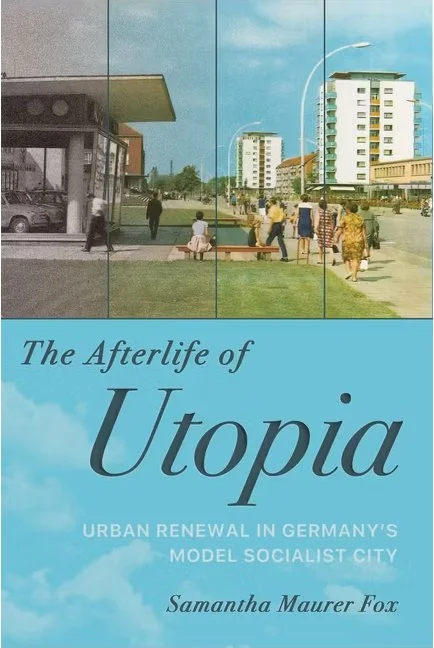
In The Afterlife of Utopia, Samantha Maurer Fox traces the transformation of Eisenhüttenstadt, East Germany's first planned socialist city, from a Cold War showcase to a paragon of sustainable shrinkage. Founded in 1950 as Stalinstadt, the city was designed to embody socialist ideals. After German reunification, Eisenhüttenstadt lost over half its population, shifting from a model city at the center of the Eastern Bloc to a shrinking city on the nation's periphery.
Fox portrays Eisenhüttenstadt's story as reinvention rather than decline. Today, its restored center is Europe's largest protected historical site, reshaped by extensive demolition and renewal projects. Fox shows how these initiatives revived the city's original collectivist ideals, creatively reclaiming socialist heritage through an urban strategy unmatched in late industrial Europe. The Afterlife of Utopia explores what happens when grand ideological experiments outlive the regimes that built them, challenging assumptions about resilience, progress, and urban futurity.